
- Written by: Kartik
- September 1, 2026
- Comments: (0)
Choosing just an English-language test can look like a simple choice between IELTS and PTE. But in practice, the right decision depends on where you are applying, which test version is accepted, how comfortable you are communicating under pressure and how much time you have before your score deadline.
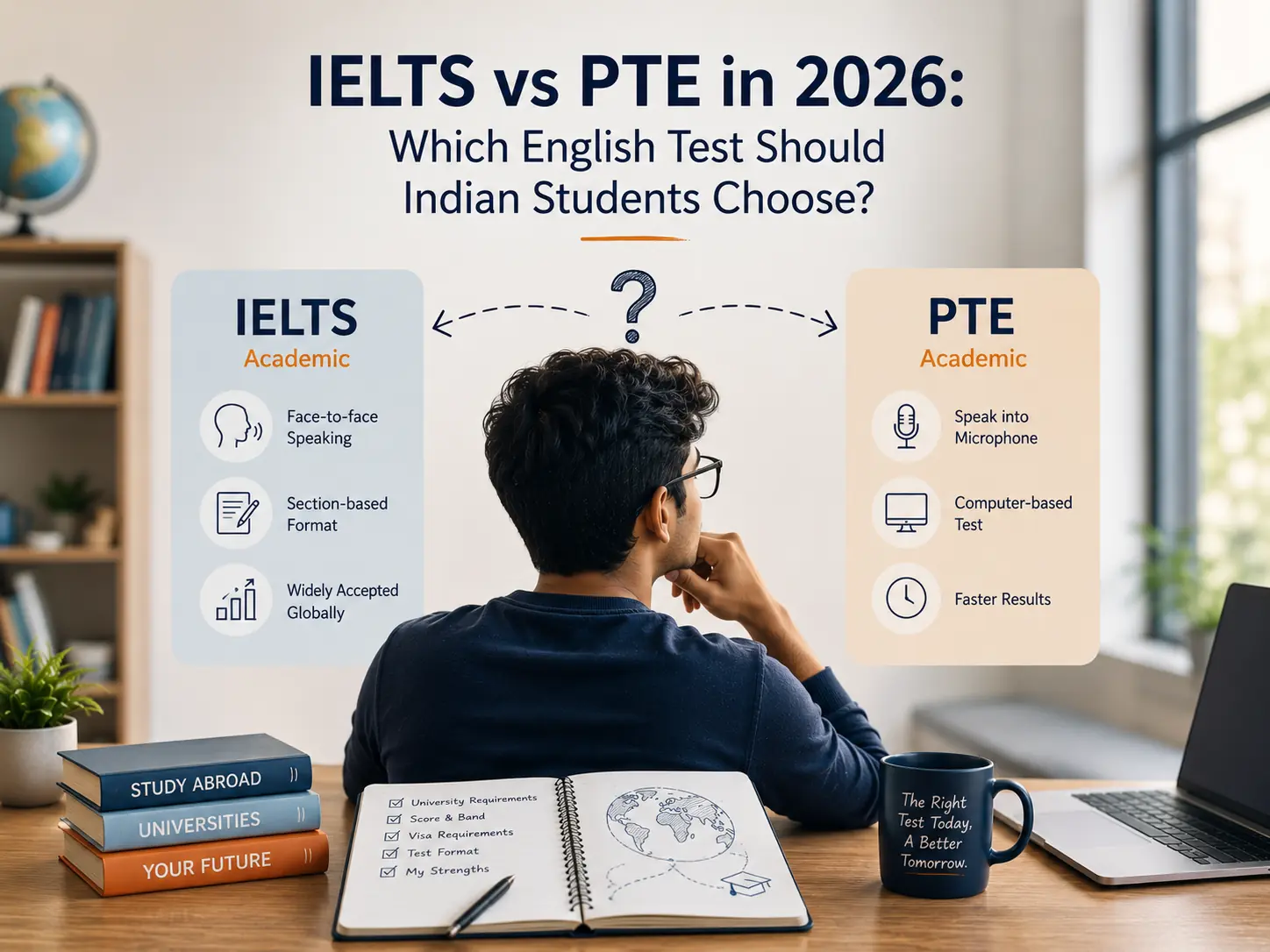
Neither of the tests are automatically easy. IELTS Academic and PTE Academic both assess your listening, reading, writing and speaking skills but they do so through different formats and scoring systems. A student who can speak comfortably with an examiner may prefer IELTS while someone who works confidently with a headset, microphone and timed computer tasks may feel more comfortable with PTE.
For Indian students, who are comparing IELTS with PTE, the safest approach for you would be to check the test’s acceptance first and your personal preference second. This guide will help you make that decision without relying on general claims about which test is “better.”
First Confirm Which Test You Actually Need
IELTS and PTE each have many different test versions. If you are applying to study in a University, the relevant options for you are typically IELTS Academic and PTE Academic. IELTS General Training, PTE Core and other versions usually serve for different purposes and should not be booked simply because their names are familiar.
The official IELTS Academic guidance describes the test as suitable for undergraduate or postgraduate study and also for certain forms of professional registration. Pearson’s official score guide similarly identifies the PTE Academic test as its academic English test and explains that the institutions set their own overall and skill-score requirements for the same.
Your visa requirements might possibly need a separate test. A university may accept your given test for admission while a particular immigration route might require another test taken through an approved version or provider. For example, PTE Academic UKVI produces a score report with a reference that the UK Government can verify.
Quick Tip: Create a list of every university, course and visa route you may use. If one test does not satisfy all of them, it may not be the practical choice even if you prefer its format.
Quick Takeaway: IELTS or PTE?
Choose IELTS if: you are more comfortable with a live speaking interview and prefer a more familiar section-based format.
Choose PTE if: you are comfortable with computer-based tasks, microphone responses and integrated question types.
IELTS Academic and PTE Academic: The Practical Differences
Decision factor | IELTS Academic | PTE Academic |
Test experience | Delivered on computer at authorised test centres; Writing on Paper may be available in selected markets. IELTS Online is also available in selected locations | Delivered on a computer at a test centre |
Speaking | A recorded, face-to-face interview with an examiner | Spoken responses are recorded through a microphone as part of the computer test |
Scoring | Overall and individual skill scores are reported on a 0–9 band scale | Overall and communicative-skill scores are reported on a 10–90 scale |
Results | IELTS on computer: 1–5 days | PTE Academic: typically 2 days, no later than 5 days |
Current format point | Listening, Reading, Writing and Speaking remain separate sections | The current test includes Summarize Group Discussion and Respond to a Situation, added for tests taken after 7 August 2025 |
IELTS Online should only be considered after checking whether your university accepts it and whether it meets the requirements of your intended visa route. IELTS states that it is an Academic test for higher education still it advises the candidates to continue using an authorised test centre for visa and other immigration purposes. A home-based option should therefore be checked against both the university’s policy and the relevant visa rules before booking.
Six Questions That Will Reveal Which Test Suits You
1. Which Test Is Accepted Across Your Complete Shortlist?
You shall begin with the official university course pages, not a general list of institutions that accept a test. Check the required overall score, minimum score in each skill, accepted test version and latest date by which the university must receive your results.
If you are applying to several countries, repeat this check for each visa route. Choose the test that keeps every realistic option open. This is more useful and efficient than selecting a test first and discovering an acceptance gap later.
2. How Do You Prefer to Speak Under Pressure?
IELTS Speaking is a live interview with an examiner and normally lasts around 11–14 minutes. Some students may find a human conversation more natural because they can respond to another person’s tone and questions. Others might become more nervous when someone is assessing them directly.
PTE requires you to speak into a microphone while the other candidates may be taking the test in the same room. This can suit those students who prefer a structured computer environment but they need to practise speaking clearly without waiting for any conversational feedback.
If you are applying to several countries, repeat this check for each visa route. Choose the test that keeps every realistic option open. This is more useful and efficient than selecting a test first and discovering an acceptance gap later.
3. Are You Comfortable With Integrated and Highly Timed Tasks?
PTE includes tasks that can involve more than one type of skill. The current format also contains sections such as Summarize Group Discussion and Respond to a Situation. Students who are using old preparation videos or notes might be therefore, practising an incomplete format.
IELTS separates the four main sections of the test more visibly. Its Writing and Speaking responses are evaluated using a published criteria while Reading and Listening answers depend heavily on the accuracy, spelling and following the stated instructions.
You can try official sample tasks from both providers before deciding on the test. Your comfort with the actual task pattern is more informative and helpful than another student’s claim that one test is easier.
4. How Close Is Your Application Deadline?
Both the tests can provide relatively quick results when the appropriate delivery mode is available. Official IELTS results guidance currently states approximately 1–5 days for IELTS on computer while Pearson says PTE results are typically available within two days and no later than five.
However, you should not plan around the advertised result window alone.. Leave some time for any unexpected delay, score review, retest and the university’s score-receipt process. A fast result is useful only if the test is accepted and you are ready to achieve the required score.
5. What Would Happen if One Skill Fell Short?
IELTS One Skill Retake may allow an eligible candidate to retake one skill where the service is offered. Acceptance for the same is not universal so the university, professional body and visa authority must each be thoroughly checked before depending on it.
You should not build your decision around a retake feature alone. You need to understand the provider’s current eligibility, timing and score-report rules, and keep enough time to retake the full test if necessary.
6. Which Official Practice Test Produces the Stronger Baseline?
Follow these steps; Complete one timed official sample or practice test for each option under realistic conditions. Record more than just the final score. Take a note of where you lost your time, whether the speaking format felt natural, how accurately you followed all the said instructions and whether one test required comparatively much more adjustment.
The better choice is often the test in which your weaknesses are much more trainable. A student who needs typing practice may improve quickly while someone who struggles with several integrated PTE tasks may prefer the clearer separation of IELTS sections.
Mistakes to Avoid When Comparing IELTS and PTE
Do not make a decision solely based on price without checking the current fee, rescheduling terms and likely retake cost on the official booking page since, fees and other policies can be changed or updated anytime.
Avoid using any kind of unofficial score-conversion tables as admission guarantees. IELTS and PTE use different scales and each institution can set its own overall and individual skill requirements. Pearson published updated concordance information in July, 2025 but a comparison table does not replace the score written on the university’s current course page.
Finally, do not prepare yourselves from the old materials available. The PTE format changed for tests after 7 August, 2025 and the test providers can revise instructions or services when necessary or needed. You can use official sample questions to confirm that your preparation reflects the test you will actually take.
Final Overview
The IELTS vs PTE decision should not be based on which test is more popular or described as easier online. It should be based on acceptance, the correct test version, your comfort with the format and the time available to reach the required score.
If your shortlist contains different English-test rules, EduGuide can help you turn them into a test-requirement map covering the accepted version, overall score, individual skill minimums and submission deadline for each course. This will give you a clear reason to book one test instead of making an expensive choice from guesswork.