
- Written by: Kartik
- September 8, 2026
- Comments: (0)
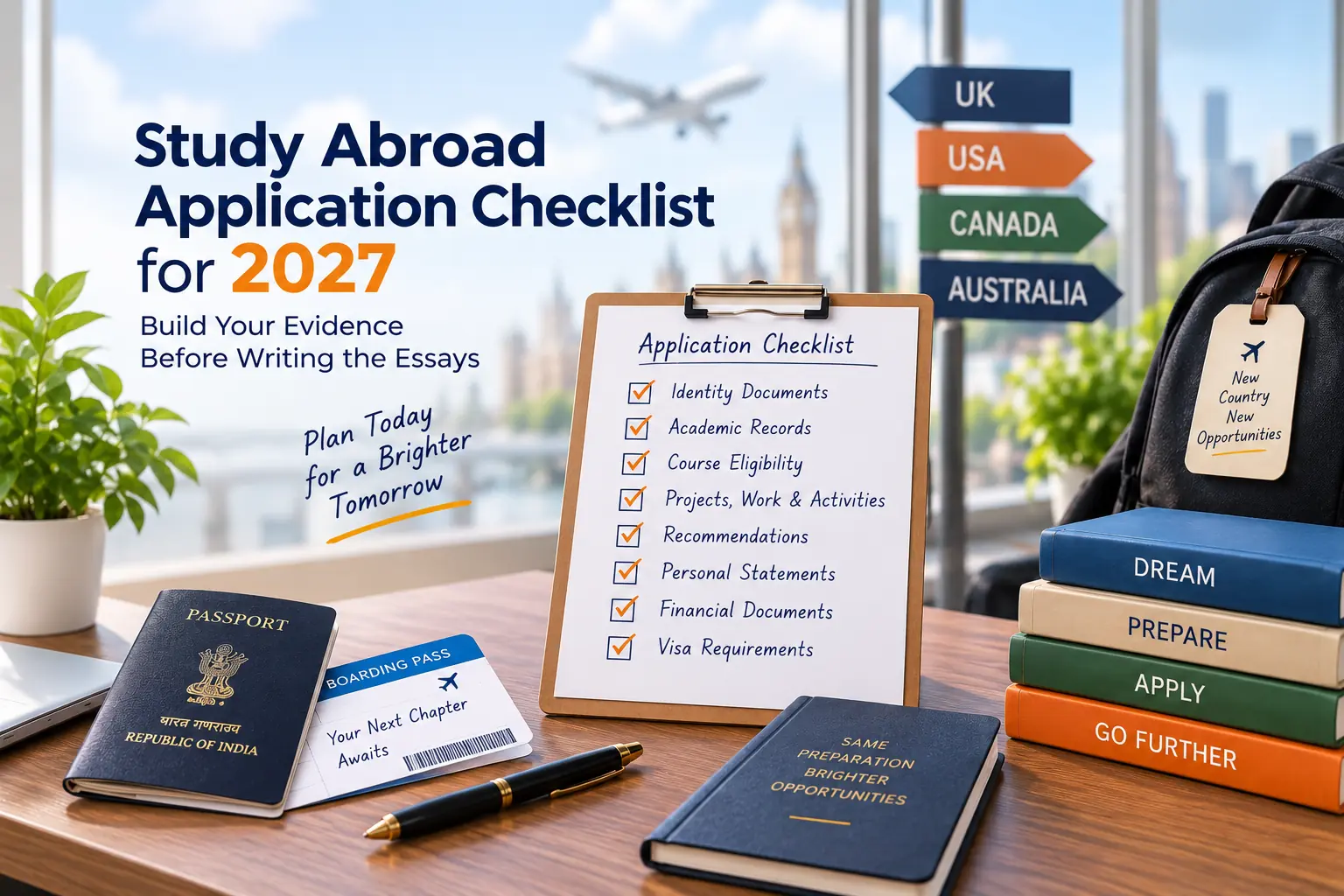
A study-abroad application can feel like a long list of documents: transcripts, test scores, recommendations, essays, financial records and more. But collecting everything on the checklist is only part of the job. The harder part is making sure the information across your application is accurate, consistent and supported by evidence.
A stronger approach here is to build an evidence file first before drafting any personal statement or university responses. This will help you in confirming your eligibility, identify missing records and making sure that every claim you make about your studies, projects or work can be supported if the university or visa authority asks for proof.
This study abroad application checklist has been designed for Indian students who are preparing for 2027 admissions. This checklist will help you create a reliable base file and then adapt it to each official application as per your requirement.
Build the Application in Eight Evidence Folders
1. Identity and Name Consistency
Start with the passport you expect to use for your application. Compare the spelling and order of your name, date of birth and other personal details across your passport, marksheets, degree certificate and test records.
If a document contains any variation, find out what explanation or correction the concerned institution will require before submitting it. Make sure to keep any official name-change certificate, affidavit or institutional clarification in the same folder where relevant.
2. Academic History
Collect your marksheets, transcripts and completion certificates that may be required for your level of study. For example, a postgraduate applicant may need semester-wise records along with a degree or provisional certificate, while an undergraduate applicant may need Class 10 and Class 12 results, whether final or predicted.
Keep a record of which universities accept an uploaded copy and which require an official transcript from your school, university or an approved credential service. EducationUSA recommends collecting transcripts well before the application deadline, as each institution may have different requirements.
If your result is still pending, note the expected issue date and check which document the university will accept in the meantime. This can help you avoid confusion when completing your application and make sure a pending result is not treated as a missing document.
3. Course Eligibility
You can create one row for every shortlisted programme and record your academic percentage or GPA, prerequisite subjects, English-language requirement, work-experience condition and any portfolio, interview or standardised-test requirement.
Don’t rely only on the university’s general admissions page. Check the specific course or department page as well. A university may accept your qualification overall while a particular course may require previous study in mathematics, programming, laboratory science or another subject.
You can mark each criterion as met, pending or unclear. This helps you confirm whether you actually meet the requirements instead of assuming you are eligible based on the course title.
If a requirement is unclear, don’t assume that you qualify. Check the programme page, application instructions or contact the university before treating it as confirmed.
4. Projects, Work and Activities
List the experiences you may discuss in an essay or résumé and attach the strongest available evidence to each one of them. This could include an experience letter, internship certificate, project report, publication, portfolio item or an official competition result.
The purpose of this is not to upload everything, it is to make sure that the description is accurate. Record what you personally did, the period involved, the tools or methods used and the outcome you can reasonably claim.
If you are unsure about a detail, check the original project report, certificate or other record rather than relying on memory when you write your application.
5. Recommendations
You must check and research how many recommendations each programme may require, who is eligible to provide them and how they must be submitted. Some portals may send a private upload link directly to the recommender while others may accept a signed letter or an institutional email.
You can ask someone who can discuss relevant work in specific terms, give them your course direction, résumé, important deadlines and a short reminder of the work they supervised. It is not advisable to write an exaggerated recommendation for someone merely to sign.
6. Personal Statements and Application Questions
Build a fact bank before you start writing. Under these four headings which are: motivation, academic preparation, experience outside the classroom and future direction, list the examples that will best explain why the programme is a logical next step for you.
Next, adapt those facts into the actual format. For UK undergraduate applications through UCAS, the personal statement is structured around three defined questions while another university may ask for one essay or several short responses. Reusing the same facts is still appropriate but copying one unchanged essay into every portal is not.
If you plan to use an AI tool for brainstorming or grammar support, check and verify every sentence and follow the institution’s rules. Your final application should remain truthful, personal and consistent with the evidence you could discuss in the interview.
A strong application does not need to sound overly polished or formal. It needs to sound like you and accurately reflect experiences you can explain if asked about them later.
7. Financial and Sponsorship Records
Keep your early budgeting separate from final visa evidence. During shortlisting, record your tuition, deposits, scholarship conditions and realistic living costs. At the visa stage, you should use only the financial documents and evidence period specified by the relevant authority.
If your parents or another eligible sponsor will provide funds, make sure their names and relationships can be documented where required. It might not be wise to move money temporarily or alter statements to create an appearance of eligibility. Financial requirements and acceptable evidence can change so re-check the official visa page when you are ready to apply.
8. Country- and Course-Specific Requirements
Your core documents will not cover every requirement. Some universities, courses and countries may ask for additional documents. Depending on your destination and programme, you may need a credential evaluation, professional-registration evidence, portfolio, research proposal, provincial or territorial attestation letter, health records or some other official documents as queried or mentioned.
For example, Canada states that a provincial or territorial attestation letter is usually required for the applicants within the affected study-permit groups but exemptions exist. You shall treat such documents as conditional requirements and check whether they apply to your exact qualification, institution and application date.
Why Evidence Matters More Than a Long Document List
Application formats are becoming more and more structured. For UK undergraduate applications through UCAS, the personal statement is now structured around three questions: why you want to study the course, how your qualifications and studies have prepared you, and what you have done outside education to prepare.
Australia’s Genuine Student requirement is another good example of why evidence matters. Applicants answer specific questions about their circumstances, why they want to study their chosen course with their chosen provider, and how the course will benefit them. Each response has a maximum of 150 words, and claims supported by evidence are given more weight.
Canada is another example of why country-specific requirements need to be checked carefully. PAL/TAL requirements depend on the applicant and study situation, and exemptions apply, including for students applying for degree-granting master’s or doctoral programs at public DLIs. Check the latest IRCC guidance for your programme and institution before applying.
Before You Submit Your Study Abroad Application
Before submitting, check the following:
- Confirm that you meet the programme-specific eligibility requirements.
- Check that your name and personal details match across your application and supporting documents.
- Confirm which documents need to be uploaded, officially verified or submitted through a specific method.
- Make sure your essays and application responses accurately reflect your actual experience and qualifications.
- Check recommendation requirements, including who can provide them and how they must be submitted.
- Verify the current financial, visa and country-specific requirements that apply to your application.
- Review the application portal to make sure every required section and document has been completed.
- Check that your application, supporting documents and written responses are consistent with each other.
- Confirm the application deadline and any separate document or supporting-material deadlines.
FAQ’s
1. What documents are required to apply to universities abroad?
Common documents may include a passport, academic transcripts and certificates, English-language test results where required, a CV or résumé, recommendation letters, personal statements or essays, and other documents requested by the university or programme. Some countries or courses may also require additional financial, credential, portfolio or immigration documents.
2. When should I start preparing my study abroad application for 2027?
Start preparing several months before your intended application deadline. Begin by checking course eligibility and collecting academic records, identity documents and other materials that may take time to obtain. Requirements and deadlines vary by university and programme, so use this checklist as a planning framework and confirm the final requirements with each institution.
3. Do all universities require the same study abroad application documents?
No. Requirements can vary by country, university, programme and study level. One university may accept an uploaded transcript while another may require an official transcript or a specific submission method. Always check the requirements for your exact programme rather than relying only on a general university admissions checklist.
4. Should I write my personal statement before collecting my documents?
It is usually better to organise your evidence first. Reviewing your academic records, projects, work experience and other supporting documents can help you identify accurate examples and avoid making claims you cannot support. Once you understand your evidence, you can adapt it to the personal statement or application questions required by each university or application system.
5. Do I need work experience to study abroad?
Not necessarily. Work-experience requirements depend on the course, university and level of study. Some programmes require professional experience, while many undergraduate and postgraduate programmes accept students without prior full-time work experience. Check the specific programme’s eligibility requirements before assuming that work experience is required or unnecessary.
Final Overview
A complete application is not the one with the largest number of attachments. It is the one in which the course choice, academic history, experiences, recommendations and written responses support the same honest story.
If your documents are ready but the requirements across universities still feel difficult to organise, EduGuide can help turn your shortlist into a personalised evidence tracker showing what is complete, what remains conditional and what must be verified before each submission. That gives you a practical working file instead of another generic document list.
A good application isn’t the one with the most documents. It is one where you can explain the important claims you have made and show how your academic record, experience and supporting documents back them up.